
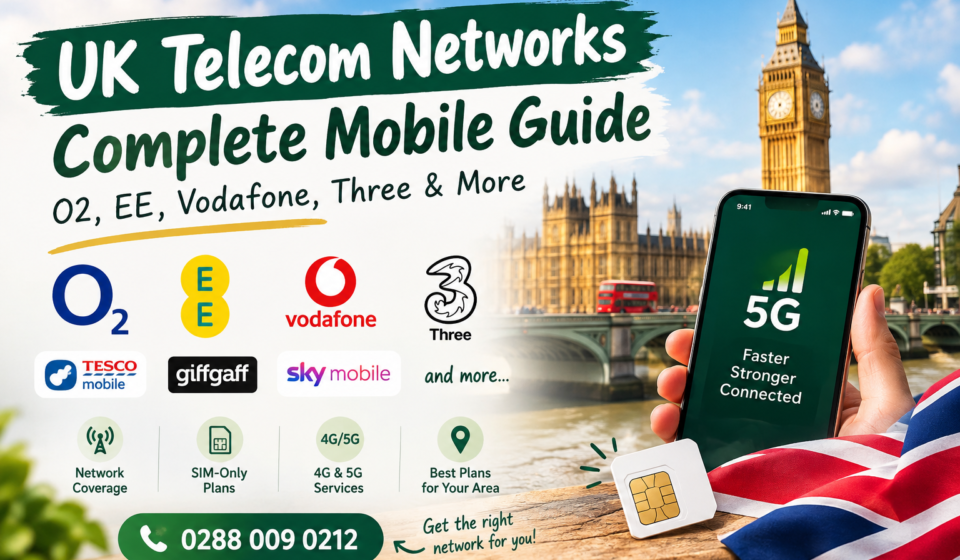
UK Telecom Networks: Complete Mobile Guide
UK Telecom Networks can feel surprisingly complicated when you start comparing mobile providers, SIM-only plans, coverage, 4G, 5G and different network brands. I have found that the easiest way to understand the UK mobile market is to look at the actual network behind each provider rather than judging every brand separately.
In the UK, four main mobile network operators provide the underlying networks: EE, O2, Vodafone and Three. Many other mobile brands use one of these networks to provide mobile services to their customers. Ofcom confirms that providers such as Tesco Mobile, giffgaff and Sky Mobile use the O2 network, while other brands operate on EE, Vodafone or Three infrastructure.
So, if you are choosing a new SIM, changing provider or simply trying to understand how UK mobile networks work, this guide gives you a straightforward place to start.
The Main UK Telecom Networks
The UK mobile market is built around four major network operators:
- EE
- O2
- Vodafone
- Three
These companies operate the core mobile networks used for calls, texts and mobile data.
There are also many smaller or virtual mobile providers, commonly known as MVNOs. They don’t necessarily operate their own nationwide radio network. Instead, they use the infrastructure of one of the major operators.
For example, Ofcom currently lists Tesco Mobile, giffgaff and Sky Mobile on the O2 network. Lebara, ASDA Mobile, Talkmobile and VOXI use Vodafone’s network, while iD Mobile and SMARTY use Three’s network. Several brands also operate through EE’s network.
This is useful to remember because two completely different mobile brands can sometimes provide service through the same underlying network.
O2
O2 is one of the UK’s four major mobile network operators and has a large customer base across the country.
O2 provides mobile calls, texts, 4G and 5G services, as well as SIM-only and handset options.
One thing I would always check before choosing O2 is the actual coverage at the places where you spend most of your time. A network can perform very well nationally but still have weaker reception in a particular building, village or rural area.
O2’s network is also used by other brands, including Tesco Mobile, giffgaff and Sky Mobile.
EE
EE is another major UK network operator and is widely used for mobile services throughout the country.
EE offers 4G and 5G connectivity alongside SIM-only and mobile phone plans. EE is also the underlying network for a number of other brands.
Ofcom lists brands including Your Co-op, 1p Mobile, Utility Warehouse, Ecotalk, Plusnet, BT Mobile and Lycamobile among providers using the EE network.
If you are considering EE, I would compare three things before making a decision: coverage where you live, the amount of data you need and the total monthly cost.
Vodafone
Vodafone is one of the UK’s main mobile network operators and provides 4G and 5G services.
Vodafone currently offers SIM-only plans, mobile phones and 5G broadband. Its website also describes 5G and 5G+ services, including standalone 5G.
Vodafone’s network is also used by brands including Lebara Mobile, ASDA Mobile, Talkmobile and VOXI.
This means that if you are comparing several of these providers, you should not look only at the brand name. It is worth checking which underlying network they use.
Three
Three is the fourth major UK mobile network operator.
Three has built its reputation around mobile data and 5G connectivity, although the best network for an individual customer still depends heavily on local coverage and network performance.
Three’s network is also used by providers such as iD Mobile, SMARTY, FreedomPop and Superdrug Mobile.
If you regularly use mobile data for streaming, social media, navigation or working away from home, checking the actual coverage around your usual locations is more useful than simply choosing a provider because it advertises fast speeds.
Tesco Mobile
Tesco Mobile is a popular UK mobile provider that operates using the O2 network.
This is an important distinction. Tesco Mobile is a separate consumer brand, but its mobile service relies on the O2 network infrastructure. Ofcom lists Tesco Mobile among the providers using O2.
Tesco Mobile can therefore be worth considering if you want a familiar retail brand while still using the underlying O2 network.
SIM-Only Plans in the UK
One of the simplest ways to reduce your monthly mobile cost is to consider a SIM-only plan.
With a SIM-only deal, you normally get the mobile service without paying for a new handset as part of the same contract.
Before choosing one, I would look at:
- Monthly price
- Data allowance
- 4G or 5G availability
- Contract length
- Coverage
- Roaming terms
- Calls and texts
- Annual price increases
- Whether the plan uses your preferred network
There is little point paying for a huge data allowance if you rarely use mobile data. On the other hand, a very cheap plan can become frustrating if you regularly run out of data.
4G and 5G in the UK
The UK’s mobile networks are continuing to move away from older technologies and toward 4G and 5G.
The UK’s 3G networks have now been switched off, while the major operators are also preparing to retire 2G services over the coming years. Ofcom says EE has announced a 2G switch-off beginning in May 2029, O2 has announced a phased 2G switch-off starting in summer 2029, and Vodafone has announced its 2G network will be switched off during 2030.
That makes having a modern 4G or 5G-compatible phone increasingly important.
For example, Tesco Mobile says its 3G network has been switched off and recommends customers using older 3G-only handsets upgrade.
How to Choose the Right UK Mobile Network
I would not choose a mobile provider simply because it has the lowest advertised price.
Instead, start with your own usage.
If you mainly use your phone for calls and messaging, you may not need a large data allowance. If you use YouTube, TikTok, Instagram, navigation, video calls or mobile hotspots regularly, data and network performance become much more important.
Your location also matters.
Ofcom’s mobile coverage information highlights several factors that can affect reception, including the distance from a mast, buildings, trees, hills, network congestion, the construction of the building and even the phone’s antenna.
So the provider that works brilliantly for one person may not be the best choice for someone living a few miles away.
Check Coverage Before Switching
This is one step I would strongly recommend before signing up for any new mobile plan.
Check the network coverage around:
- Your home
- Your workplace
- Your regular travel route
- Places you visit frequently
Don’t rely entirely on a national coverage claim. Local conditions can make a noticeable difference.
Ofcom provides a UK mobile coverage checker covering the four main network operators, and its results can help you compare network availability in your area.
Which UK Telecom Network Is Best?
There isn’t one network that is automatically best for everyone.
EE, O2, Vodafone and Three all have extensive UK networks, but the right choice depends on where you live, how much data you use, the type of phone you have and the price you are comfortable paying.
I would always compare coverage + price + data + contract terms rather than looking at just one of these factors.
It is also worth remembering that a cheaper mobile brand may use the same underlying network as a more expensive brand. Understanding the network behind the provider can therefore make your comparison much easier.
Final Thoughts
Choosing between UK mobile providers doesn’t have to be complicated.
Once you understand the difference between the four main networks and the many brands that use them, comparing mobile plans becomes much easier. Start by checking coverage, work out how much data you actually need and then compare the total cost of the plan.
And if you are unsure which type of UK mobile service may suit your requirements, you can get further information using the contact option below.
Please note: This article is provided for general informational purposes. Mobile coverage, prices, plans and network policies can change, so always check the relevant provider’s current terms before making a decision.